Before I understood infrastructure, finance, or industrial strategy, I understood the Quebec Nordiques.
I understood what it felt like to love a team at the bottom of the standings. I understood what it meant to watch a small-market city hold on to hope through bad seasons and draft picks and rebuilds. Then came Eric Lindros.
Lindros did not want to play in Quebec. At the time that felt like one more humiliation. But the trade that followed became one of the most important in hockey history. The Nordiques turned a rejected superstar into the foundation of a contender. Peter Forsberg. Mike Ricci. Ron Hextall. Steve Duchesne. Picks, money, depth. After years near the bottom, Quebec suddenly had the bones of something powerful.
And then the team left.
In 1995 the Nordiques moved to Colorado and became the Avalanche. They won the Stanley Cup in their first season there. For Quebec fans it was not only that the team had gone. It was that the future we had suffered for arrived almost immediately, wearing someone else's jersey.
Then the final insult. Patrick Roy, the legendary goaltender of the Montreal Canadiens, Quebec's great rival, was traded to Colorado that same season and helped secure the Cup. The team Quebec lost, strengthened by a legend from its arch-enemy, became a champion somewhere else.
Years later Quebec City tried to build its way back into that future. A new NHL-ready arena went up. Quebecor invested. Politicians supported the dream. Fans believed. The container was there.
But the NHL never returned.
I do not feel about artificial intelligence the way I felt about the Nordiques. Nothing in technology has ever done to me what that team did when I was a kid. Hockey and AI have nothing to do with each other, except that Quebec City taught me what it looks like when a place builds its way toward a future it does not control.
Every bit of it was real: the arena, the millions invested, the civic pride, and the hope. The only thing missing was the league itself.
The machine that knows one trick
Canada may end up domesticating AI by turning it into real estate.
Not because data centres are useless. They are not. But because data centres are the version of AI that Canada's existing economic machine already knows how to finance: land, construction, permits, power contracts, leases, debt, infrastructure funds, pension allocations, insurance-backed long-duration assets, bank lending.
That is very different from building deep AI capability.
Canada has spent decades getting excellent at turning physical assets into balance-sheet products. Residential real estate alone sat at roughly $8.47 trillion on Canadian household balance sheets in early 2026. Household credit-market debt reached about $3.25 trillion, close to $1.80 of debt for every dollar of disposable income. Residential mortgage debt passed $2.4 trillion by the end of 2025. When people say real estate is central to the Canadian economy, that is not a vibe. It is a structural fact.
Data centres fit beautifully into that structure.
A single data centre can be pitched as a land development project, a construction project, a commercial real estate asset, a pension cash-flow asset, a sovereign AI project, and a national productivity strategy.
That is politically powerful, because almost every incumbent can find their own story inside it. The bank sees lending. The pension fund sees contracted cash flow. The insurer sees duration. The province sees construction jobs and property-tax base. The federal government sees sovereignty. The utility sees demand growth. The developer sees land value. The tech company sees subsidized capacity.
Nobody on that list has to be wrong, cynical, or corrupt. Each one is doing what its balance sheet already knows how to do. That is exactly why this could become Canada's default AI strategy even if it is not Canada's best AI strategy.
The pipeline is already committed
This is not a forecast. It is underway, and this month, for the first time, someone measured it.
A working paper by Alexander Carlo and Lyndsey Rolheiser at York University's Schulich School of Business maps every Canadian data centre across its full lifecycle, from announcement through construction to activation. Their numbers describe a machine that has already made its decision.
The operational base is modest. 194 active facilities, 1.6 gigawatts of capacity, average size 11.3 megawatts. The announced and under-construction pipeline is 22.2 gigawatts, nearly fourteen times the existing base, at an average facility size of 122 megawatts.
The geography tells you what kind of project this is. Active data centres sit on sites averaging about 13 acres, roughly 19 kilometres from a downtown. Announced facilities average nearly 2,000 acres, 134 kilometres from the nearest major city.
Thirteen acres near a downtown is digital infrastructure. Two thousand acres, two hours out, is land development.
One more number for scale. The researchers calculate that a single average announced facility, at realistic utilization, would draw the electricity of somewhere between 49,000 and 78,000 Canadian households.
Where the machine runs hottest
The federal Sovereign AI Compute Strategy is the visible layer: up to $700 million for domestic compute, up to $1 billion for public supercomputing, up to $300 million for an AI Compute Access Fund. Call it roughly $2 billion.
The real work is provincial and private. Alberta accounts for 92 per cent of Canada's planned data-centre capacity while hosting about 3 per cent of what is active today. The province is targeting $100 billion in private investment over five years, supported by a concierge program to streamline approvals, municipal property-tax deferrals of up to 15 years, and a deregulated power market that lets developers bring their own natural gas generation instead of waiting in the grid queue.
Canada's entire sovereign compute strategy is roughly $2 billion. Hyperscaler capital spending is projected at about $725 billion in a single year. Canada's public play is roughly 0.3% of one year of incumbent spending.
Ottawa's program is the press release. Alberta is the machine, already running. That does not mean Canada should stay out of AI infrastructure. It means Canada cannot afford to confuse participation with strategy. If the scale game is unwinnable, the only serious question left is what strategic capability $2 billion can actually buy. Leverage is in the layers that survive a hardware cycle. Talent that stays. Research and applied capability that compound. Institutions that understand the technology well enough to govern it. More buildings is the most familiar answer available to Canadian finance. It is also the answer that buys the least of any of those things.
The box and the thing inside it
Here is the problem with financing AI like real estate. A data centre is not one asset. It is layers of assets with very different lifespans.
Engineering assessments put the building shell at 50 years or more. The internal installations, power and cooling, last around 20. The servers themselves may last as little as five.
The financial system prices the asset off the 50-year layer. The strategic value lives in the five-year layer.
That mismatch is not a detail. It is the whole problem. Banks, insurers, and pension funds underwrite data centres with the logic of long-duration infrastructure, the logic of a toll road or an office tower. But the layer that makes the asset strategically valuable ages faster than the debt against it. Even the incumbents cannot agree on how fast. Hyperscalers have been extending server depreciation schedules in their own accounting while skeptics argue AI hardware goes obsolete faster than the books admit. The market is openly uncertain about the lifespan of the valuable layer. Canadian institutional capital is underwriting it as though it lasts forever.
Have you noticed how the bet gets sold? Cold climate, cheap power, land, water, political stability. Building data centres sounds like the conservative play, the one that leans on our traditional strengths. But it is only conservative if the current AI paradigm holds. It is exposed to chip architecture changes, cooling changes, model-efficiency gains, inference moving closer to users, export controls, vendor lock-in, and the open question of whether enormous training runs stay the centre of gravity at all.
A bet that is conservative in its inputs and speculative in its assumptions is not a conservative bet.
Sort the risks by which layer they attack and the picture organizes itself. The shell faces grid bottlenecks and siting fights. The installations face expensive retrofits when power density and cooling architecture shift. The servers face obsolescence, export controls, and paradigm risk. Above all of it sits the political risk: a country mistaking hosting compute on Canadian soil for AI sovereignty.
The landlord and the tenant
Say the buildings get built and filled. Who owns the game inside?
The Schulich paper answers this directly, and the answer sharpens as the facilities get bigger. Among pipeline projects of 100 megawatts and up, US-headquartered firms account for 85 per cent of identified providers, 100 per cent of financial backers, and 100 per cent of end users. The larger the facility, the more foreign the ownership. The authors note that local populations carry the costs of expansion, the electricity demand, the emissions, the water risk, while returns on the underlying assets may accrue outside the province or outside Canada entirely.
That is landlord economics. Canada finances the shell, hosts the power draw, and collects the rent. The tenant keeps the capability, the intellectual property, the pricing power, and the margins, and books the profits wherever suits it. Canada collects property tax on the building and payment for the electricity. The value created by the intelligence inside is taxed somewhere else.
The employment story is just as lopsided, and it is documented. Hyperscale facilities run on skeleton crews: security, facilities staff, technicians. US research cited in the same paper found that tax-incentive-driven data-centre construction changed where facilities got built without producing local tech employment growth. The construction jobs are real, and temporary. That is the employment profile of a real estate project, not an industry.
So the opportunity cost has a shape. Canada would be spending scarce capital, grid capacity, and political attention on the lowest-jobs-per-dollar form of AI participation, while the high-employment layer, the labs and the applied firms and the people, keeps leaking south.
Whose money is on the table
Now the part that involves you whether you follow AI or not.
Canadian institutional capital is already in the trade. CPP Investments committed C$225 million in construction financing for a hyperscale expansion in Cambridge, Ontario. It committed up to roughly C$1 billion alongside data-centre operator CtrlS in India, and joined a multi-billion-dollar data-centre platform in Australia. La Caisse provided $240 million in senior debt for an AI-ready facility in Montréal.
The public-market exposure is bigger, and stranger. Across the observable US equity filings of Canada's eight largest pension funds, the Maple 8, holdings in AI infrastructure firms grew from about $12.6 billion just before ChatGPT launched to about $64.5 billion by early 2026. A fivefold increase in under four years, concentrated not in data-centre operators but in the cloud platforms and chipmakers sitting above them. For several funds, AI infrastructure now represents fifteen to twenty per cent of their disclosed US equity portfolios.
Put the two facts side by side. Canadian retirement savings are increasingly long the AI boom through shares of the tenants. The physical facilities on Canadian soil are majority foreign-owned, and grow more foreign as they grow larger. Canadians hold slivers of the tenants and almost none of the buildings. Exposed at both ends, in control of neither.
No single one of these positions is reckless. Each is small against the size of the fund holding it. The concern is not any one bet. It is that banks, insurers, pension funds, and governments are converging on the same asset class at the same moment, pricing it with the same long-duration logic, exposed to the same short-lived layer. Diversification across institutions does not help when the institutions are all making the same bet.
Canada has seen this pattern before. No single mortgage was the problem either.
So why does nobody say no?
In a diversified economy, sectors fight. Manufacturing wants cheap land and energy. Tech wants talent and risk capital. Exporters want competitiveness. Banks want credit growth. That friction is messy, but it is also an early-warning system. When a strategy tilts too far toward one interest, some other interest complains loudly and pays lobbyists to keep complaining.
Canada gets described as more socialist than the United States because of universal healthcare. Then I look at housing, and we appear remarkably comfortable treating one of life's basic necessities as an investment vehicle. That made me wonder whether housing is the exception or the lens.
The more I read of Canada's AI strategy, the more familiar it sounded. We weren't really talking about AI. We were talking about land, electricity, construction, financing, leases. Once you notice the pattern you cannot stop seeing it.
The problem is not that Canada's institutions are identical. It is that too many of the powerful ones have learned to win the same way, through land appreciation, construction, credit creation, and long-duration assets. When the opportunity is phrased as turn AI into land, power, leases, and infrastructure, all of them can read it without translation. The conclusion arrives pre-approved.
The people on the other side of the arrangement exist. Renters. Young workers. Researchers who leave. Manufacturers squeezed on power costs. But they have op-eds, not balance sheets. The friction is real. It just has no institutional voice.
Canada ran this experiment with housing. The warnings were published for twenty years. Look how much they changed.
Policy Horizons already wrote the warning
There is a stranger detail in all this. One arm of the federal government has already described where the road can lead.
Policy Horizons Canada, the federal foresight agency, published a scenario report on the future of social mobility. It describes a plausible 2040 in which most Canadians are locked into the socioeconomic conditions of their birth. Property ownership divides society more than income does. Inheritance becomes the main path to security. The value of human labour shrinks under AI. And people who want to climb emigrate to places where climbing still feels possible.
Reading it, I could not tell whether the report was describing the future or documenting something already underway.
Since 2000, Canadian home prices have risen more than four times faster than household incomes.
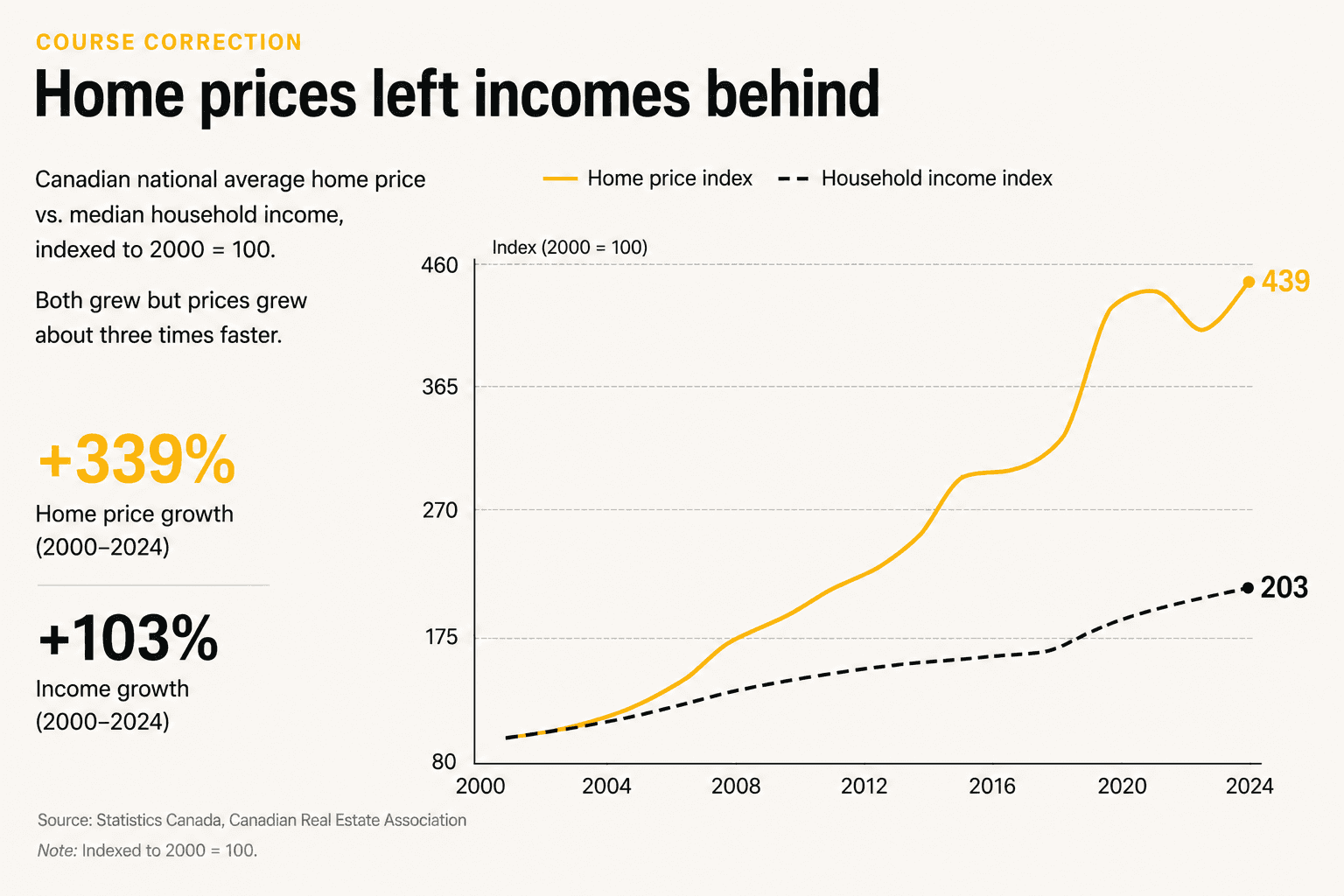
If wealth increasingly depends on owning assets rather than earning income, mobility gets harder with each generation. So how speculative is a scenario that says social mobility may decline by 2040?
Now set that scenario beside the strategy. A data-centre-led AI policy produces returns that flow to property and existing capital. It creates few permanent jobs. Its profits are booked mostly elsewhere. Every mechanism runs in the direction the foresight report warns about.
This is not hypocrisy and it is not a conspiracy. It is non-communication. The foresight unit is a smoke detector that was never wired to anything. The warning exists, in the government's own hand. The machine cannot hear it, because every institution that opens the file arrives at the same familiar answer.
The arena, again
Most criticism of AI data centres focuses on what they consume. Water, electricity, land, quiet. Those concerns are legitimate. But there is another question Canada has barely started asking.
What if the problem is not only what data centres consume, but what they let us avoid building?
If Canada spends its limited sovereign AI capital on the physical layer because that is the layer our financial system understands, we may end up with useful buildings, long leases, and impressive announcements, and none of the capability that makes a country sovereign in anything.
Quebec City's arena was not useless. It hosts concerts and junior hockey. The construction was real. The civic pride was real. The hope was real.
But the league was somewhere else, and the league decided.
A city can build the perfect container for a future it does not control. So can a country.


